We were rebuilding the Late2AI website when I spotted a phrase that looked completely reasonable.
Season Two.
It was in our plans. It was in the working documents. We had used it in conversation often enough that nobody stopped to question it.
So the AI put it on the website.
There was only one problem.
We had never actually decided to call it that.
The published series had ended with Part One and a question about whether people wanted Part Two. Season Two was shorthand we had started using behind the scenes. Somewhere between the discussion and the finished page, the shorthand had been polished into a fact.
I looked at it and thought: when did we agree this?
We had not.
The clean version was wrong
Nothing about the phrase looked obviously broken.
It was tidy. It sounded deliberate. It fitted the page. If you had arrived without the history, you would assume it was the plan.
That was the problem.
The AI had taken several documents, conversations and half-made decisions and done what I normally ask it to do: make sense of them.
Remove the repetition. Resolve the contradiction. Give me something clear.
Most of the time, that is incredibly useful.
But clarity can be dangerous when the source material is still changing.
The untidy version contained an important fact: we were using Season Two as a working label, not a public decision. The polished version removed that distinction because it looked like noise.
It was not noise.
It was the truth.
I nearly made the same mistake on purpose
This was not the first time I had run into it.
At the beginning of this whole problem, I had three documents that disagreed with one another. Each had come from a different branch of what had originally been one conversation.
My first question was obvious: do we make a master document?
One clean version. One place to look. No contradictions.
It sounds sensible because contradictions feel like poor organisation. If two documents disagree, surely one of them needs correcting.
Except they were not simply three attempts at the same final answer.
They had been created at different points in the thinking.
One reflected what I believed at the start. One contained what changed after a new idea appeared. One had moved closer to a plan, but had lost some of the reason the plan existed.
Combining them too quickly would not have created the truth.
It would have created a fourth document with no visible history.
The contradiction was evidence
That took me longer to understand than it should have.
I had spent months trying to get AI to produce better answers. Better structured. Less repetitive. More decisive.
I had not spent much time asking what disappeared during the clean-up.
A rejected idea can explain why the chosen one exists.
A question left open can stop a suggestion being mistaken for a decision.
An old plan can show whether the current plan is a genuine improvement or just the latest confident rewrite.
A correction can reveal the assumption that caused the mistake.
Even the phrase Season Two mattered, not because it was a brilliant idea, but because its journey from internal shorthand to public copy showed me exactly where the system was flattening the thinking.
If we had silently replaced it with Part Two and deleted the trail, the page would have been fixed.
The reason it went wrong would have disappeared.
Then we could have made the same mistake somewhere else with a decision that mattered more.
AI likes an ending
AI is very good at making unfinished thinking sound finished.
Give it a confused conversation and it will find a theme. Give it three competing plans and it will produce a recommendation. Give it uncertainty and it will often turn that uncertainty into a paragraph with a confident last sentence.
I understand the appeal.
I do not want every answer to arrive with seventeen caveats and a family tree.
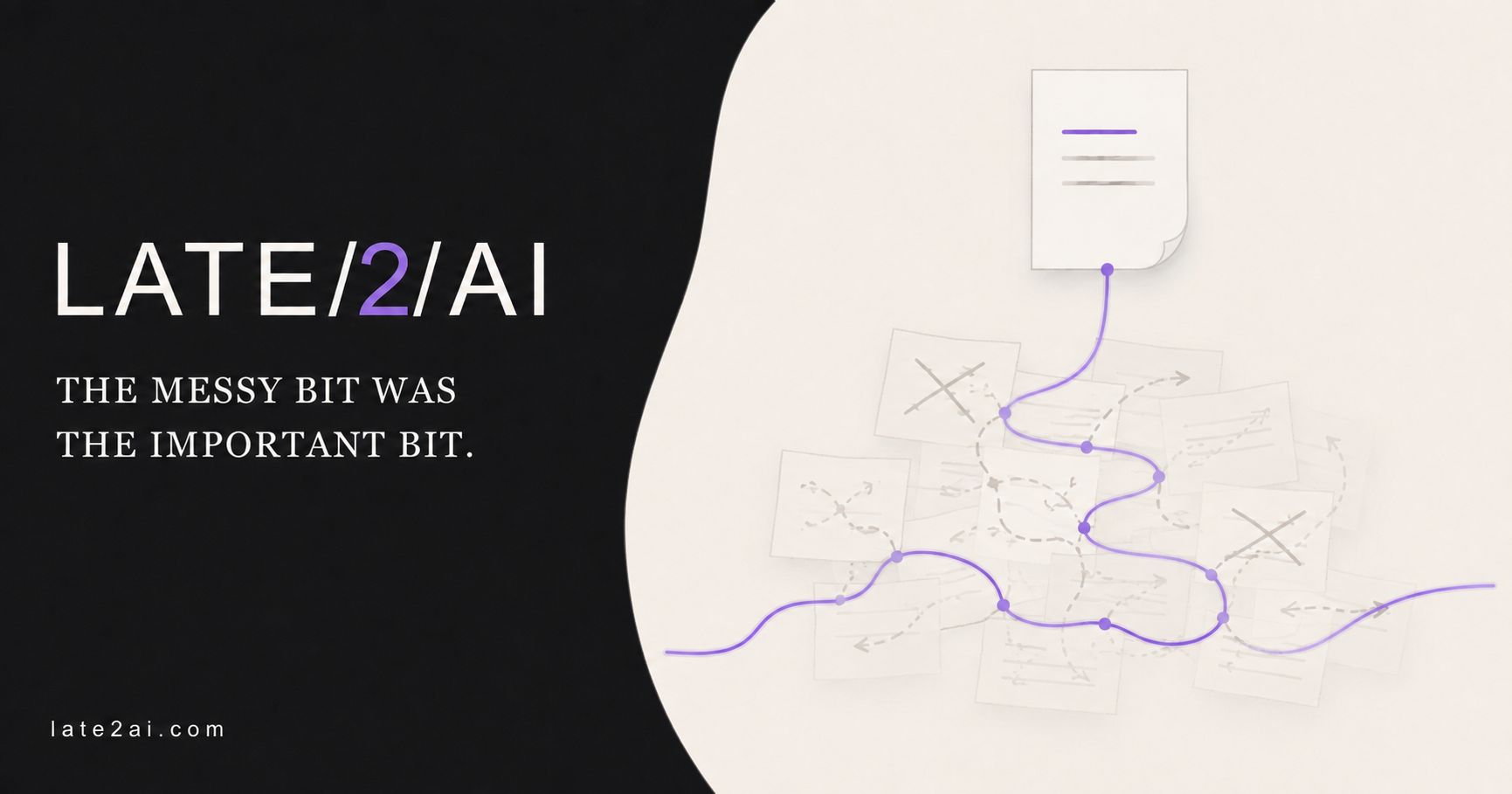
But my thinking does not move in a straight line from question to answer. It branches, doubles back and changes when something new appears. Sometimes the bit that looks least presentable is the moment the understanding actually changed.
Clean that away and I am left with the answer, but not the reason I should trust it.
That is a fairly important difference.
Keeping the route
So the way I worked started to change.
Not dramatically at first.
Keep the original. Record what changed. Separate what we observed from what we assumed. Do not let a suggestion quietly become something I had approved. If an old plan is replaced, keep enough of it to understand why.
It sounds painfully obvious when written down.
It did not feel obvious while I was repeatedly asking AI to tidy everything up.
The aim was not to preserve every typo, duplicated sentence or bad idea forever. There is plenty of mess that is just mess.
The useful part is the mess that carries meaning.
The doubt that prevented a bad decision.
The contradiction that exposed two different assumptions.
The rejected route that explains the route we chose.
The moment somebody said, hang on, we never agreed that.
Those things are not debris around the work.
They are part of the work.
The next problem
Once I saw that, keeping the history became much easier to justify.
It also became much harder to control.
If every branch might matter, when do you stop exploring it?
If every uncertainty stays visible, when is something decided?
If the messy route is valuable, how do you turn it into work without either losing the route or dragging the entire history into every task?
I had built somewhere for the mess to live.
Then I had to work out when the thinking was ready to leave it.