The computer crashed.
When I came back, part of the conversation appeared to be missing.
Not a document I had forgotten to save. Not a file sitting in the wrong folder. The actual conversation we had been using to make decisions, create the new Late2AI artwork and work out what happened next.
Some of it was there.
Some of it was not.
So I found myself asking an AI whether it could recover the history of the conversation I had just been having with it.
There is something beautifully ridiculous about that sentence.
It was also the moment the problem stopped being theoretical.
The work was inside the conversation
I had always treated chats as places where work happened.
Open a conversation. Explain the problem. Explore it. Make a decision. Create the thing. Move on.
The final output might end up somewhere else, but the route to it stayed in the chat.
That route contained more than waffle.
It contained the ideas we had rejected. The detail that changed my mind. The reason one option was safe and another was not. The moment I corrected something the AI had misunderstood. The difference between something I had approved and something we were merely discussing.
When part of the conversation disappeared, the final files did not suddenly become useless.
They became harder to trust.
I could see what had been produced.
I could not easily see how it had become true.
Recovering the chat was not the answer
We did recover it.
A raw snapshot was preserved. A readable transcript was created. The decisions and outstanding work were reconstructed far enough for us to continue.
That felt like a win.
But recovering one conversation after a crash was only another repair.
If the thinking mattered, I could not leave its only useful history inside the same interface that had lost it.
I needed somewhere outside the conversation.
Not a master document. I had already learned what happens when every idea, decision and half-finished thought is polished into one apparently definitive answer.
The contradictions disappear.
So does the truth about how you got there.
What I needed was somewhere that could hold the mess without pretending the mess had already been resolved.
The Dock
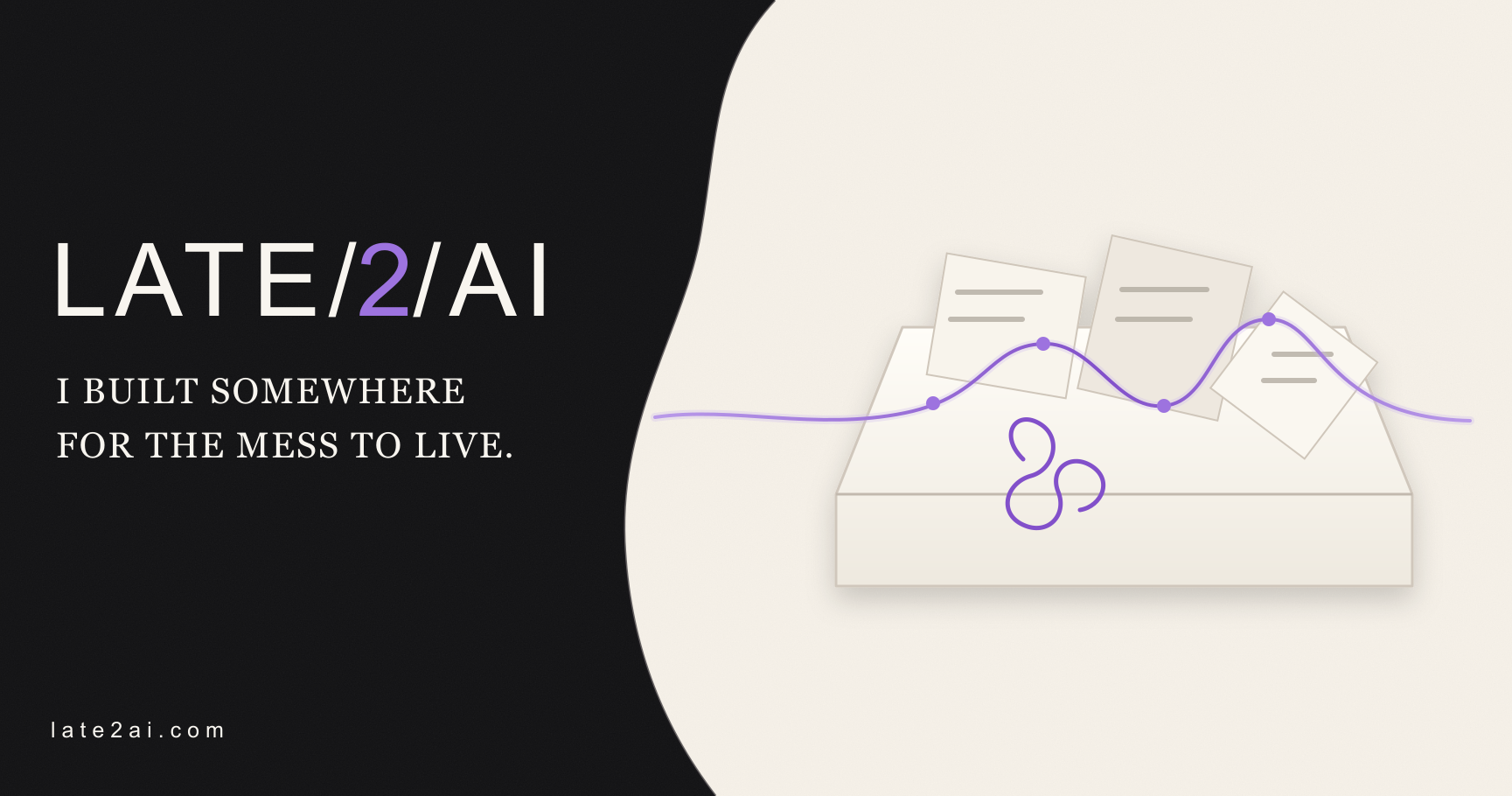
That place became the Dock.
At first, it looked less impressive than the AI systems I had spent months building.
Mostly words. Files. Dates. Versions. Records saying what had been observed, what I had decided and what was still open.
No clever avatar. No animated command centre. No agent introducing itself as Head of Something Important.
But it could do something the chats could not.
It could keep the source conversation separate from the decision made from it.
It could keep an old plan without allowing the old plan to pretend it was still current.
It could say this is evidence, this is an assumption, this is a proposal and this is something James has actually approved.
It could preserve a rejected route instead of deleting it, because the reason it was rejected might matter later.
Most importantly, it could survive the conversation ending.
Somewhere, not something
I was very tempted to turn this into another system.
Give it a grand name. Draw an architecture diagram. Create categories for everything before I had enough experience to know what the categories should be.
I did some of that, obviously. I am still me.
But the useful shift was much simpler.
I stopped asking one AI chat to be the conversation, the memory, the project plan, the evidence file and the final authority all at once.
The chat could be where we thought.
The Dock could be where we preserved what happened to that thinking.
One was allowed to move quickly.
The other had to make change visible.
That distinction became the beginning of what I have been calling the James Operating System.
Not because I sat down and decided the world needed another framework.
Because I needed a way to come back after a crash, a new chat or three weeks away and know what was true without relying on an AI to tell a convincing story about what it vaguely remembered.
The mess had value
The strange thing was that the Dock became useful because it did not begin with the polished answer.
It held the unfinished parts.
The awkward questions. The conflicting documents. The decisions waiting for me. The evidence that weakened an idea I liked. The branch we had parked but not killed.
In a normal document, those things look untidy.
In the work itself, they are often the most important things there.
I had spent months trying to make AI give me cleaner answers.
What I eventually built was somewhere safe enough to keep the untidy route to them.
That solved the immediate problem.
It also created the next one.
Because once all the mess had somewhere to live, I had to learn which parts of it must never be tidied away.