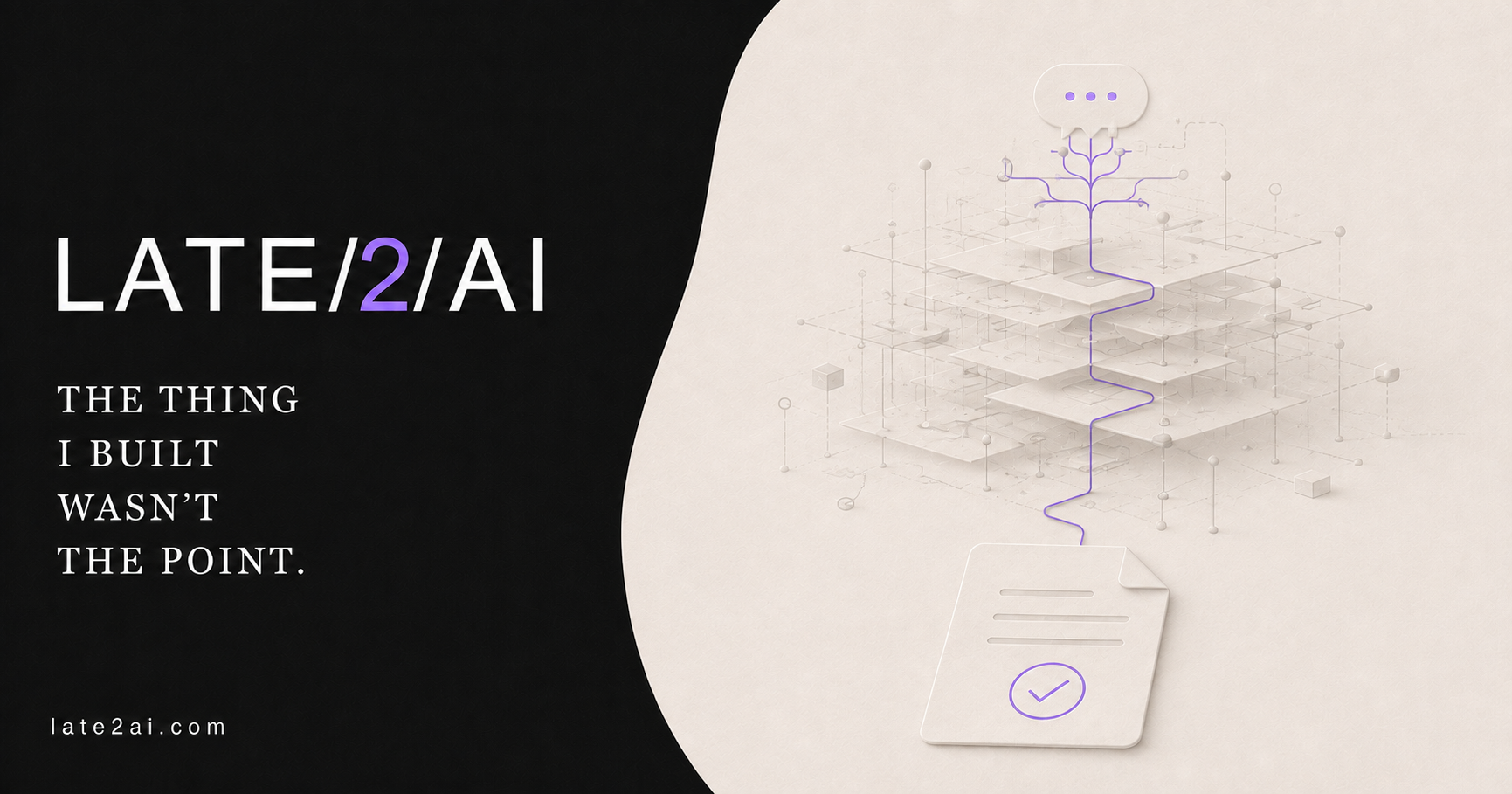
When I started writing Late to AI, I told everyone I used to fix boilers and was now building AI systems.
It was a good line because the distance between those two things sounded ridiculous.
It also put the emphasis in the wrong place.
The interesting bit was never that somebody who used to fix boilers could build a complicated system.
The interesting bit was why I needed one.
Before there was a system
I am dyslexic.
I think verbally. My brain moves in branches and connections. One thought becomes three before I have finished explaining the first one.
The professional world tends to want the opposite.
Straight lines. Clean documents. Meeting notes. Follow-ups. Decisions captured in the right place and in the right order.
I have spent most of my career finding ways to close the gap between how I think and how work expects thinking to arrive.
Then I found AI.
I expected a slightly better search engine.
What I found was something that could often understand what I was trying to say before I had properly said it.
I could talk. It could help turn the talking into writing.
That was the useful thing.
It happened before the agents. Before the databases. Before I knew enough technical language to make any of it sound impressive.
Then the build became the story
The first script worked.
That made me wonder what else could work.
One script became several. The scripts became agents. The agents needed memory. The memory needed a proper database. The database needed structure. The structure needed controls, dashboards and things to check the other things.
Every sensible answer created a more complicated question.
Somewhere along the way, I stopped describing AI as the thing helping me work and started describing the system as the work.
The numbers sounded good.
More than fifty agent names. Twenty-two after the audit. Thirty-eight jobs. A hundred and twenty database tables. Thousands of records. An entire architecture that I could draw on a screen and explain to people who understood software.
I was proud of it.
I still am, in parts.
But the system had started asking me to serve it.
Read these briefings. Approve these actions. Resolve these conflicts. Check these outputs. Fix this memory. Decide which document is true.
I had built machinery to reduce the gap between thought and action.
Then I filled the gap with machinery.
Taking it apart showed me what mattered
This latest run started with one conversation becoming three ideas, three chats and three documents that did not know the others existed.
That small problem contained nearly everything I had learned.
The AI could help me think, but it could not automatically preserve the shape of the thinking.
Memory was not the same as understanding.
A document was not useful merely because it existed.
An agent completing a task could still create more work for me.
A confident answer could still be wrong.
The answer was not another bigger system.
It was learning to make the system smaller around the truth.
One place for the work to live. Clear ownership. Fewer agents with actual jobs. A route from conversation to decision. Proof at the same level as the claim.
None of those things is particularly exciting on its own.
Together, they create something I did not have before.
A way for a messy, branching thought to survive long enough to become useful work.
The system is scaffolding
I used to think the system was the achievement.
Now I think it is scaffolding.
Scaffolding matters. If it is badly built, people get hurt. If it is in the wrong place, the work becomes harder. If you keep adding to it without a plan, eventually you cannot see the building.
But nobody puts up scaffolding because they wanted scaffolding.
The point is what it allows you to make.
For me, that is not an autonomous workforce operating while I sleep.
It is more ordinary and more valuable.
It is finishing a thought.
It is coming out of a meeting with the important bits still intact.
It is turning a conversation into a decision without losing the branches that made the decision sensible.
It is doing less work to make my thinking legible to everyone else.
It is having more time and attention left for the parts of my job that actually need me.
I am still building
This is not the end where I tell you I have solved it.
I have not.
The tools will change. The models will change. I will almost certainly build something unnecessary again because apparently that is how I prefer to learn.
But the question has changed.
I no longer ask how much AI I can put into my work.
I ask what friction should disappear if the AI is doing its job.
I no longer count agents.
I look for human work that no longer needs to happen.
I no longer trust the diagram.
I look at whether the real thing works for the person standing at the end of it.
The thing I built taught me all of that.
But the thing I built was never the point.
The point was building a way of working that fits the way I think.
I am still late to AI.
I am just no longer trying to catch up by building faster.